



Osteochondrosis of the thoracic spine, in contrast to cervical and lumbar osteochondrosis, is very rare.
It's all about the structure of the thoracic region: it has more discs than the cervical and lumbar spine combined, the discs are smaller and thinner.The mobility of this section is generally lower, and part of the load is taken on by the ribs and sternum.
With osteochondrosis of the thoracic spine, the symptoms can be confused, for example, with a heart attack.The reason for this is the specificity of the disease.
In this case, there are no painful pains during movement and exertion, as with cervical or lumbar osteochondrosis, and complications associated with suspected angina pectoris or myocardial infarction or impaired respiratory function come to the fore.
Reasons
To a greater extent, the development of osteochondrosis is promoted by physical inactivity - a deficiency of muscle loads, which forms the lack of training of the muscle corset, weakening of its functions and increased load on the ligaments and intervertebral discs.
The following conditions can provoke the occurrence of osteochondrosis:
- Incorrect posture and lateral curvature of the spine;
- Bad habits;
- Nervous and physical overstrain, stress;
- Overload of the back and spine when wearing high-heeled shoes, during pregnancy and flat feet;
- Back injuries;
- Physical inactivity;
- Heredity;
- Physically hard work.
The intervertebral discs of the thoracic vertebrae are equally adversely affected by a sedentary lifestyle and physical activity, which increases the likelihood of injury.
What are the specific features of the thoracic spine?
Everyone knows that the thoracic region is functionally inactive, in particular when compared with the neck.And the load on it is not so great, relative to, for example, the lumbar region.For this reason, the occurrence of thoracic disease rarely occurs with any symptoms at an early stage of development.
Low mobility of the thoracic spine is associated with its anatomical features - the connection of the vertebrae with the ribs and sternum makes it possible to create a sufficiently mobile and, at the same time, durable structure, which is less susceptible to injury and external influences.

The relatively small load on this department contributes to the fact that the occurrence of any problems in it (for example, displacement of the vertebrae, intervertebral hernia, disc protrusion) are quite rare, this is confirmed by statistics.However, their appearance cannot be called something extraordinary; for example, poor posture and scoliosis can be some kind of provoking factors leading to the occurrence of spinal diseases.
At the same time, the symptoms of such diseases appear quite late and are quite characteristic of osteochondrosis - they usually represent compression of the nerve roots; in rare cases, the spinal cord itself may be compressed or damaged due to impaired blood supply; narrowing as a result of compression of veins and arteries is also possible.
Symptoms of osteochondrosis of the thoracic spine
Osteochondrosis of the thoracic spine can have completely different symptoms, similar to the manifestations of other diseases of the internal organs.Often it is thoracic osteochondrosis that is mistaken for coronary heart disease, cholecystitis, peptic ulcer, and even myocardial infarction and pneumonia.For this reason, this disease is called a “chameleon”.
Symptoms associated with pain:
- The pain is localized below the shoulder blades and can radiate to the intercostal nerves.This leads to neuralgia.The pain increases when a person takes a breath or actively moves.
- Chest pain is most often localized on the left side and may resemble coronary heart disease.In this situation, it is important to find out in time the reason why the pain appeared.It is necessary to fully examine the cardiovascular system.
Neurological symptoms:
- Numbness or “crawling” in the legs, upper chest and abdomen (depending on the affected disc);
- Reflex tension in the muscles of the chest or upper back;
- In particularly advanced cases, it is possible to disrupt the functioning of the pelvic organs and reduce potency in men.
Symptoms of osteochondrosis of the thoracic spine, in addition to pain in the spine and back area, near the site of osteochondrosis may also include pain in the upper abdomen, heart, liver, and gall bladder.
When such pain occurs, misdiagnosis is sometimes possible.Pain in the right side of the chest under the ribs can be confused with inflammation of the gallbladder, in the left side of the chest it can be confused with a heart attack.It is a mistake to mistake pain in the corresponding areas of the abdominal cavity for a manifestation of a stomach ulcer or gastritis.
Dorsago
Dorsago is one of the symptoms of osteochondrosis of the thoracic spine, which is manifested by acute pain.Typically, this symptom occurs in people who sit for a long time in one position or in an uncomfortable position, while performing monotonous work.
Pain may occur in the spine in the thoracic region, muscles become tense, and it is often even difficult to breathe.Intercostal neuralgia may occur.
Dorsalgia
The exacerbation period will last 2-3 weeks.At the same time, the pain gradually increases.Mild pain appears in the affected part of the spine.As a rule, pain manifests itself especially actively when breathing deeply and bending forward, backward, or to the sides.
The nature of pain during dorsalgia can be very different.The pain can be pulling, burning, aching, cutting, and can radiate to the leg, arm, buttock, or shoulder blade.The location of the pain is no less varied.They can appear below, above, in the middle, on the right, on the left, between the shoulder blades.
Treatment of osteochondrosis of the thoracic spine
When drawing up a treatment plan that determines how to treat osteochondrosis of the thoracic region, diagnostic data based on an X-ray examination help.Such an examination gives a clear idea of how to treat thoracic osteochondrosis, because x-ray readings indicating the proliferation of vertebral bodies and the presence of changes in the intervertebral distance (decreased height) are a characteristic symptom of this disease.
Treatment of osteochondrosis of the thoracic spine depends on the stage of the disease and mainly comes down to conservative therapy.Surgery is extremely rare in cases of spina bifida.
Drug treatment
Drug therapy is based on the following principles:
- Using a special drug that allows you to retain fluid inside the intervertebral disc.
- Vitamins.Most often, complete vitamin complexes or preparations with B-group elements are prescribed.
- Antispasmodics and muscle relaxants that reduce spasm of the muscles surrounding the spine.
- Painkillers.NSAIDs and analgesics based on drug combinations.
- Chondroprotectors.Necessary to catalyze the process of restoration of damaged cartilage.
After the elimination of acute phenomena, massage of the muscles of the back and lower extremities is used.Manual therapy is indicated for grades 1-3 of osteochondrosis in the case of the development of functional blockades.It includes various options for soft and rough effects on the back muscles.
The duration of treatment for osteochondrosis of the thoracic spine depends on the severity of the disease and the degree of age-related changes, as well as on the diligence of the patient in following the prescriptions of the attending physician.
Gymnastics for thoracic osteochondrosis
For osteochondrosis of the thoracic spine, patients are prescribed therapeutic exercises, the main goal of which is to increase the mobility of the costovertebral and intervertebral joints.Exercise therapy (provided that the exercises are performed regularly and correctly) can eliminate even very strong muscle spasms.Moderate physical activity will help relieve stiffness in the spinal column that occurs with a weak muscle corset.
Daily exercises, conducted under the supervision of an experienced instructor, will have a beneficial effect on the entire body as a whole, and in particular on the bronchopulmonary system.Patients' lung ventilation improves, and they become able to take deep breaths and exhales painlessly.
Massage

Massage not only reduces the severity of the symptoms of the disease, but also helps a person recover, resulting in positive effects from other elements of complex therapy.
It is prescribed individually based on the clinical picture of osteochondrosis of the thoracic spine, the presence of chronic diseases and contraindications.
Manual therapy
Manual therapy is used to eliminate muscle hypertonicity and spasms, as well as to restore back mobility.Thanks to manual therapy, it is possible to free up blood vessels, improve nutrition and oxygen supply to the tissues of the intervertebral discs.
Correct position when resting and sleeping
To prevent osteochondrosis and during the treatment period, it is necessary to organize the correct position during rest and sleep.It is best if you sleep on a flat and hard bed, but this should be done without fanaticism; if the bed does not meet the requirements, it is not recommended to sleep on the floor, as you may catch a cold.This measure is very necessary so that the spine can quickly restore its normal shape.
However, at first, quite intense pain may appear, which persists until the vertebrae take a physiological position.To relieve pain and discomfort, you can place a roller under the sore area.
Exercises
The most effective treatment for muscle spasms is physical therapy.Properly selected exercises relax, and at the same time strengthen and train the back muscles.As a result, the thoracic spine is stabilized and the pinched spinal nerves are released.
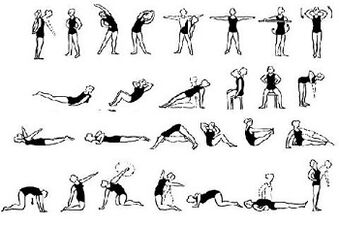
A set of exercises for thoracic osteochondrosis is carried out as follows:
- Starting position: while inhaling, stand straight, legs together, arms down.Stretch your arms up - exhale, then bend back - take a deep breath.Lower your arms, lean forward, round your back and lower your shoulders and head - exhale.Perform 8 - 10 repetitions.
- Starting position: sitting on a chair.Slowly place your hands behind your head - inhale, bend back 5 times, leaning on the back of the chair with your shoulder blades - exhale.
- Starting position - get on all fours and bend your back as much as possible, hold for 3 seconds, keeping your head straight for three seconds.Perform 5 - 7 repetitions.
- Starting position - lie comfortably on your stomach and rest your hands on the floor.At the same time, bend back with force and try to lift your body off the floor.Perform 5 - 8 repetitions.
- Starting position: lying on your stomach with your arms extended along your body.Bend over in the chest, trying to lift your head and legs up as much as possible.Perform 5 - 8 repetitions.
If you follow all the doctor’s instructions, then slowly but surely you can achieve a significant improvement in your condition.
Prevention
The health of the thoracic and other parts of the spine can be harmed by:
- long static loads (sitting in front of the TV, computer);
- lifting weights;
- habit of slouching;
- hypothermia and frequent colds.
Office workers who spend long periods of time at the workplace due to their duties need to change their body position more often, get up, and do physical exercises.Even simple stretching brings benefits.